
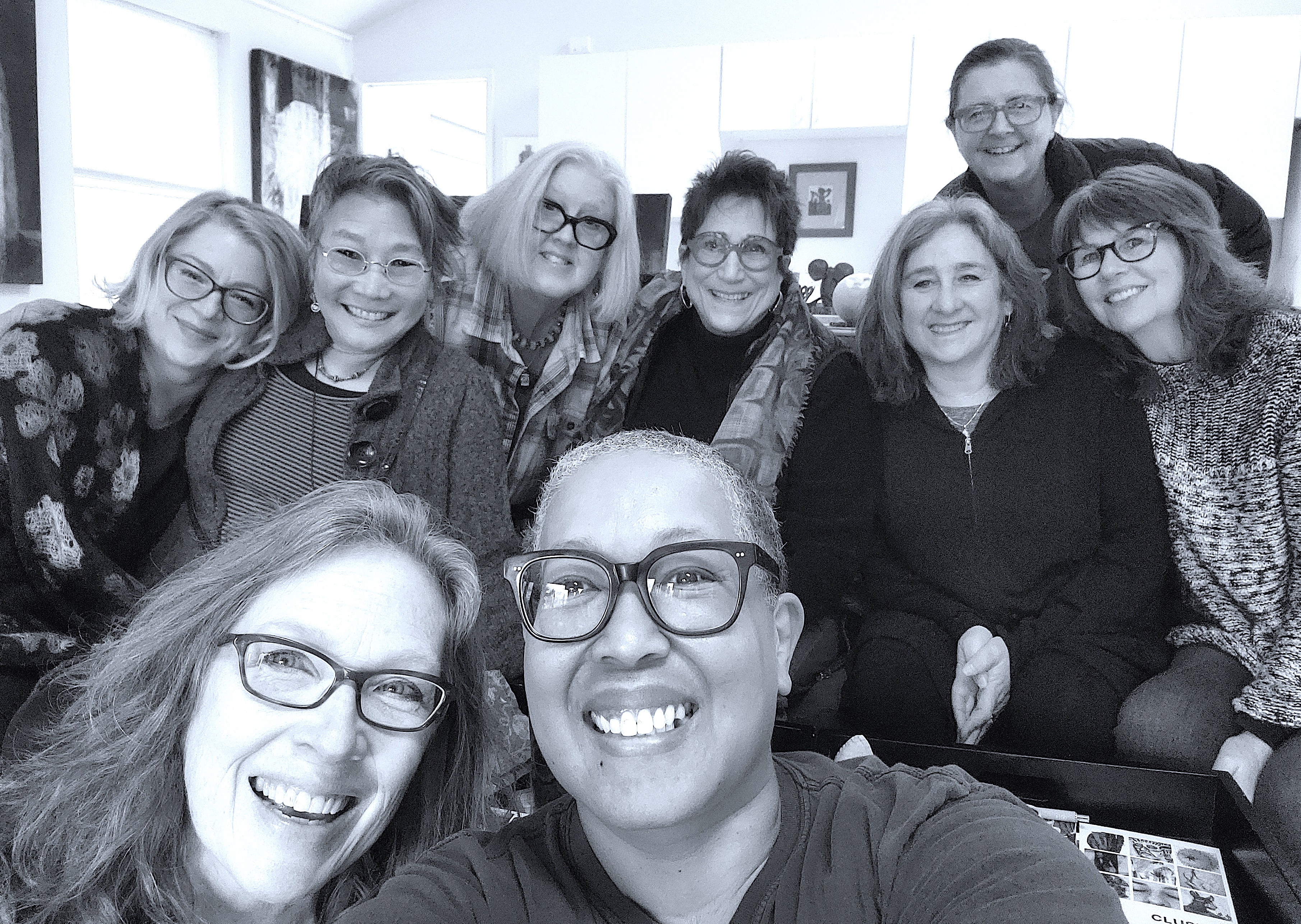
I am a member of two art collectives: CLUSTER (Seattle based) and ConvergenceAtr3D7 (International)

I WEAVE A NEST OF FOIL
BY ARLENE NAGANAWA
Reviewed by Nina Burokas
No One Praises Ordinary
It’s usually dim here, anyway.
Fog blurs our imperfections. Don’t you miss
the magic of the darkroom, chemicals
and negatives, the slow appearance of faces?
The highway is ugly but beautiful.
The joy of getting from one place
to the next and another next from there.
What is it we weave in and of this world? Every action—indeed, each discrete choice—a statement of intention, an expression of self. The result: both a map and a nest.
I Weave a Nest of Foil is poet and poetry teacher/mentor Arlene Naganawa’s first full-length poetry collection, proceeded by her chapbooks Private Graveyard (Gribble Press), The Scarecrow Bride (Red Bird Chapbooks), The Ark and the Bear (Floating Bridge Press), and We Were Talking About When We Had Bodies (Ravenna Press). The visual and tactile experience—interior design by Steve Connell, printing by Bookmobile on 100-pound white Lynx paper—complements Arlene’s precise, imagistic narrative. Even the Table of Contents beckons; the two section titles are: “Tell You What” and “This Dream Has a Trapdoor.”
I first experienced Arlene’s writing at CLUSTER’s “Who What When” exhibition at Aurora Loop Gallery in Port Townsend. Each of the eight final pieces began as a 12 x 18 watercolor, going through seven stages of creation/modification based on the prompt sequence Who, What, When, Where, Why, How and So What. Arelene’s role was to craft an overarching “So What” for each work that acknowledged both the individual contributions and the final composition. Her poems were the point that the pieces came together for me—a distillation of the visual narrative filtered through Arlene’s consciousness and infused with her fierce wit. To excerpt, her “So What” of the fourth piece, titled “How You Love,” starts with the “clean numbers” of mathematics, “where everything is fair” and closes with:
Oh, zip unzip
the talons inside
your wildest longings
still tear you apart.
I admit to hesitating before entering I Weave a Nest of Foil’s opening poem, thinking what good could come from a poem titled “CVS”? But, oh—I recognized myself in the first line … in the thwarted intention and the craving, packaged for consumption, for the delusion of need and satisfaction. Arlene then extends this sense of familiar unsettlement, drawing a connection to angels, taking the sacrament and God. … In her poems, our very existence seems to be a “thin” or perhaps porous place.
I had given up the material world
but was tempted by snacks in cellophane bags.
I searched for thin places where the spirit
might find me, where angels might touch
my blue dress. Plastic cups lined a counter:
gold, translucent red. I ran my finger round
the lips, as if a sacrament. I could hardly
believe the bounty, aisles wide and clean,
shelves of hair ties and Kleenex. Surely God
must enter through the automatic doors.
PERHAPS THE MOST POTENT TAKEAWAY FROM MY EXPERIENCE OF ARLENE’S WORK…IS THE REMINDER THAT WE HAVE A PRIMARY ROLE AS MAKERS AND CURATORS OF CULTURE—AND, PERHAPS, REALITY.
Although her voice is clear and distinct in both the “Who What When” exhibit poems and the poems in this collection, I noticed a distinct difference in tone and structure. Of course, this makes sense. The exhibit was a collaborative project; Arlene’s final “So What” served as curation and closure. In I Weave A Nest of Foil, Arlene’s poems feel like an invitation. I’m reminded of a point CMarie Fuhrman made in a recent Stafford Challenge presentation addressing craft as content. Speaking of form, she noted that “… gaps and jumps in a poem also invite the reader to participate … in the creation of meaning” and shared a prompt she uses with her students: “will you make room in this poem for me?” Arlene not only makes room for the reader, she makes room for all manner of being: of flesh, faith, and myth, and, perhaps, most importantly, that dim space beyond consciousness.
In “Invitation,” her repetition of “let them…” is hypnotic, contributing to a sense of being, as the ghosts are, in a pass-through or transitory state—a sensibility underscored by the goodwill wishes.
ghosts linger in the pass-through
let them sleep in our bed
let them roll in mothy complications
let them turn their faces to our faces
let them give us their icy handshakes
let them open like flashlights
let them turn bedsheets into pages
let them scribble goodwill wishes
The poems in this collection seem to blur reality—specific, grounded images that resolve in reverberation (this reader’s gasp), as in this excerpt from “A Story”:
But there is only the lift of terns over the thrift gone purple in
the crevices
between rocks scattering the backshore, sand left /
whisperless…
For me, the most intriguing aspect of Arlene’s poetry is how she draws connections between seemingly disparate experiences, infusing this weaving with language that dispels the “fog” of ordinary. I particularly enjoyed the free association in this excerpt from “A Time”:
7
Shelling peas from the market, I saw why shells are called so, / crisp shells in the boathouse, oars lifting like fins skimming the waves. // Racing shells, shells to protect, shells dropped in a pot, boiled.
Arlene’s poems don’t invite so much as incite curiosity. I think of CLUSTER’s aid and abet positioning: “aiding and abetting our fellow members in this [visual art] lifestyle we have chosen.” Arlene’s poems incite imagination and an exploration of both form and language. Similarly, I experienced several stanzas as an opportunity for meditation. For example, consider this excerpt from “The Girl”: “Every time I climb into the boat, someone says a prayer. / Each dip of the oar is newborn and finished, all at once.”
There is a spare, sculptural beauty to some of Arlene’s poems—an aspect heightened by the design and printing. In “Madeline,” this precision is applied to an evocative scene that erases the separation between the speaker and nature. In the last four stanzas, line length, alliteration, and imagery drive the narrative to conclusion. To excerpt:
I was a windfall
wild apple
wasp trapped
in foxglove
I was still
as a lake
frozen
over.
I experienced I Weave a Nest of Foil as a journey—experiencing the joy of moving from poem to poem, allowing the imagery to, paraphrasing Arlene, open me like a flashlight. These poems invite not only a savoring of language and imagery but expansion—a heightened awareness of self and being. I think of Elizabeth Austin’s signature nudge toward the end of a free write: “what else is true?” And the way that question hangs in the air—an assumption—prompting further, wider inquiry. Perhaps the most potent takeaway from my experience of Arlene’s work—in collaboration and individually—is the reminder that we have a primary role as makers and curators of culture—and, perhaps, reality.
A writer and educator, Nina Burokas’ poetry appears in Port Angeles Fine Arts Center’s Sculpture Park, the anthologies This Machine is Made for Earth, Inspired by Art, Teacakes & Tarot and Winter in America (Again; in her chapbook, Wintering, and online at Unleash Lit and Silver Birch Press. Ekphrastic work was included in the 2025 Assisi International Contemporary Art Exhibit and appears in the “Telephone” exhibit online. She frequently reviews books for Raven Chronicles. An adjunct business instructor at Mendocino College in California, Nina has been a contributing author/editor for five digital business titles.
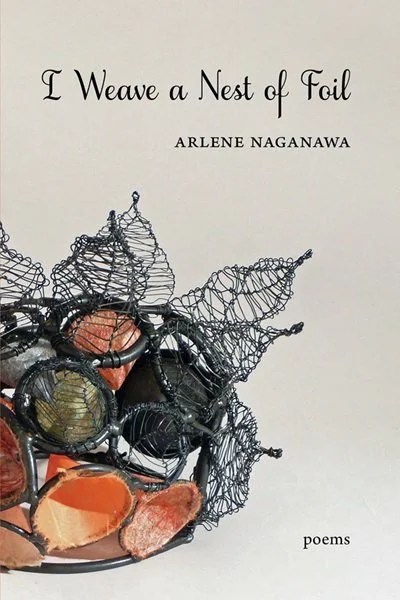
I Weave A Nest of Foil
By Arlene Naganawa
Artwork by Rickie Wolfe
ISBN: 979-8-218-32090-4
Kelson Books,
David Oates, General Editor
2033 SE Lincoln, Portland, OR 97214
April 2024, paperback, 59 pages, $22.00
 STEPHANIE HARGRAVE STUDIO