
Hargrave’s work is about biology – the science of life in all its forms especially with reference to origin, growth, reproduction, structure, and behavior. Biology is the large umbrella that allows for all manner of exploration beneath it. Focusing on biology emphasizes a movement-based world view – evolving thinking versus that which is static. Her process aligns with scientific discovery; ever unfolding, open to restructuring with new information. Prior work centered on botany, organisms, and cell structures – photosynthesis essentially, but more recently she has concentrated on insects, mycology, bones, horns, structural growth patterns and the ocean, including non-photosynthesis dependent life forms. Abstracting bodies, whether human or animal, on both a macro and micro level, began as the Covid epidemic unfolded.
While living in New York, she submerged herself in the study of deep-sea creatures and bioluminescence to sooth herself during lock-down. Above ground was devastating, but the ocean felt calm. It resulted in a series of nearly black dark Prussian blue and white paintings that reference jellies, feel like soft aquatic monsters, and are intended to resemble x-rays and angiograms. This series, titled Hybrid, unfolded at a residency in upstate NY at Judy Pfaff’s art compound, where nightly, the fireflies would surround her after turning off the studio lights.

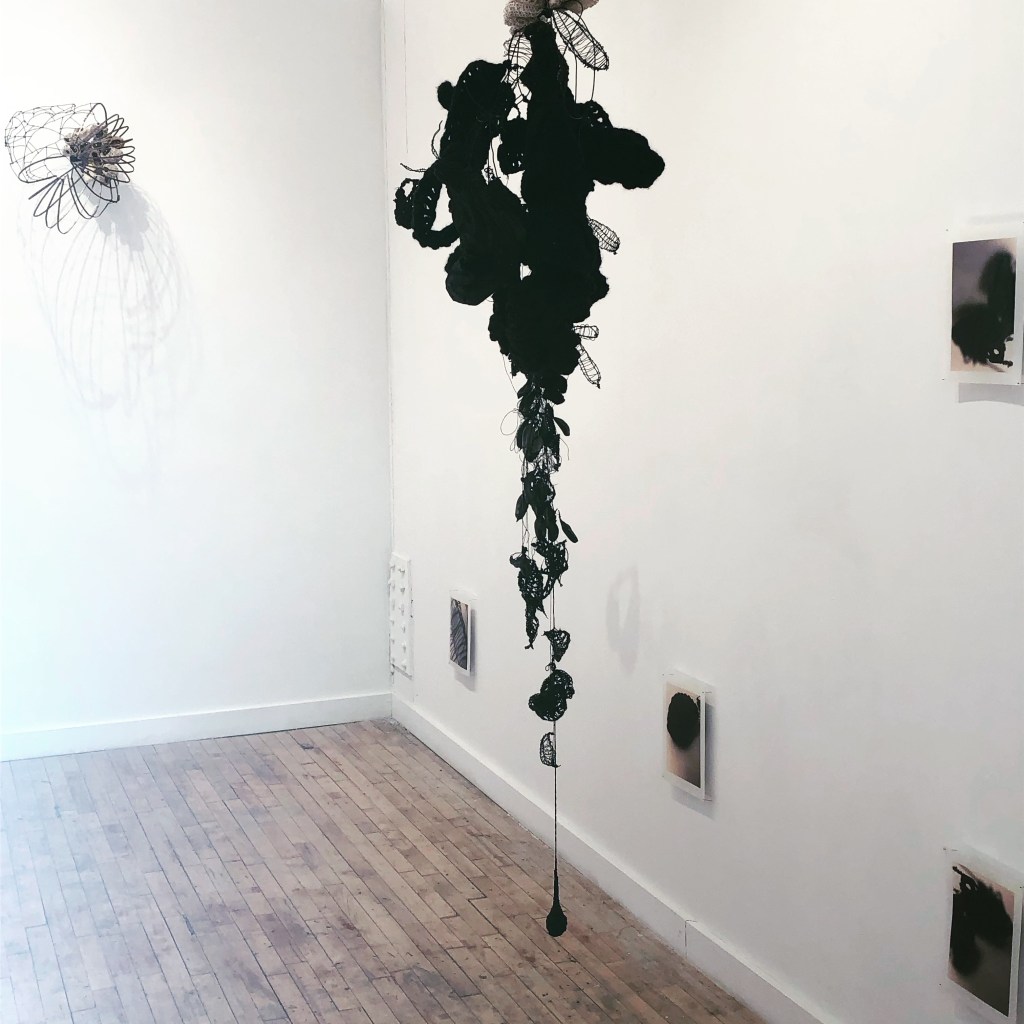
At a Brooklyn residency in 2019 she created an installation (shown below) that combined etymology and entomology; the concept combined arthropods and the words once used to refer to them. Titled Semantic Drift it included photographs of crocheted insect-like forms printed on Kozo paper, infused with beeswax, and attached to the wall with specimen pins. The originals, made with cotton string dyed black, were bundled together, titled Biomass, and hung from the ceiling near her metal ‘nest’ sculpture that cast an insect wing shadow.
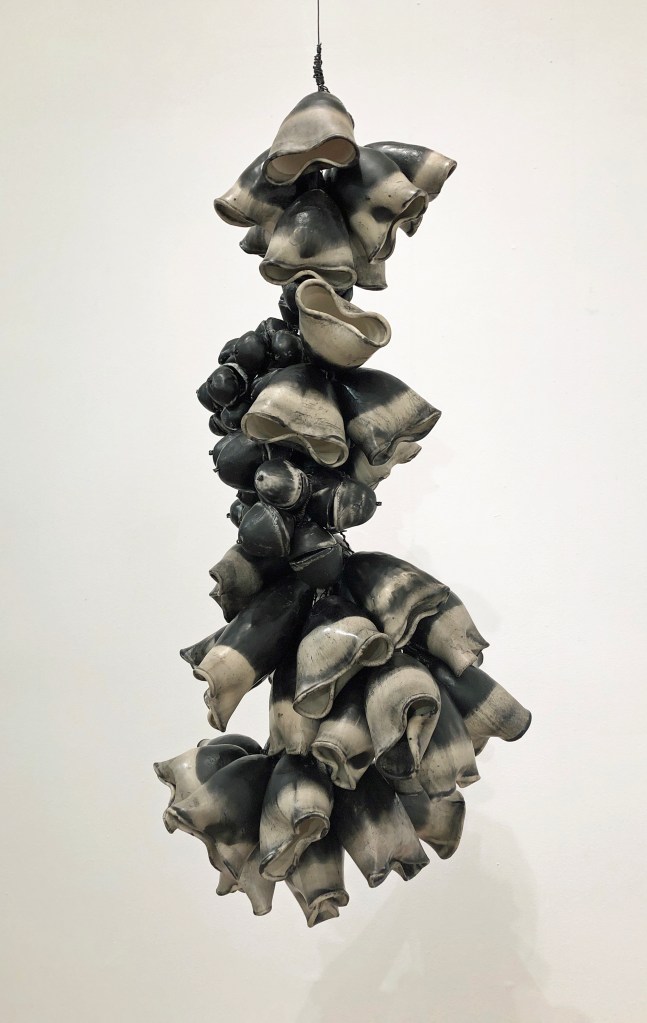
That same year, her porcelain sculpture Magical Thinking (below)was favorably critiqued by David Cohen of Art Critical. The torso sized grouping of hand pinched bell-forms finished in black encaustic pays homage to the medicinal qualities of mushrooms. Hung freely, it sways slowly with the air movement in the room and floats visually, in blatant disregard to its weight.
Whatever her focus, the underlying premise is constant; biological functioning, and how we understand ourselves and the world we live in from that perspective. By abstracting bodily forms and cellular growth, Hargrave aims to allow for a wide array of entry points into the work. She makes organic-looking objects that omit realism but could easily exist. Natural forms made from natural materials is key, but not necessary. She works mainly with porcelain, stoneware, wood, steel, beeswax and paper. Recently Yupo paper has been incorporated; a smooth synthetic ‘paper’ that allows for wonderful gradations as the ink evaporates off its non-porous surface. Beautiful light pinks become serene and tissue-like, but it can also be used to achieve chaotic surfaces, almost photographic in quality.
Making is the most satisfying aspect of her practice but sharing it with an audience is vital. That is the moment connections are made and move naturally into something new – something resembling growth. This process mimics biological functioning and completes the circle.
 STEPHANIE HARGRAVE STUDIO